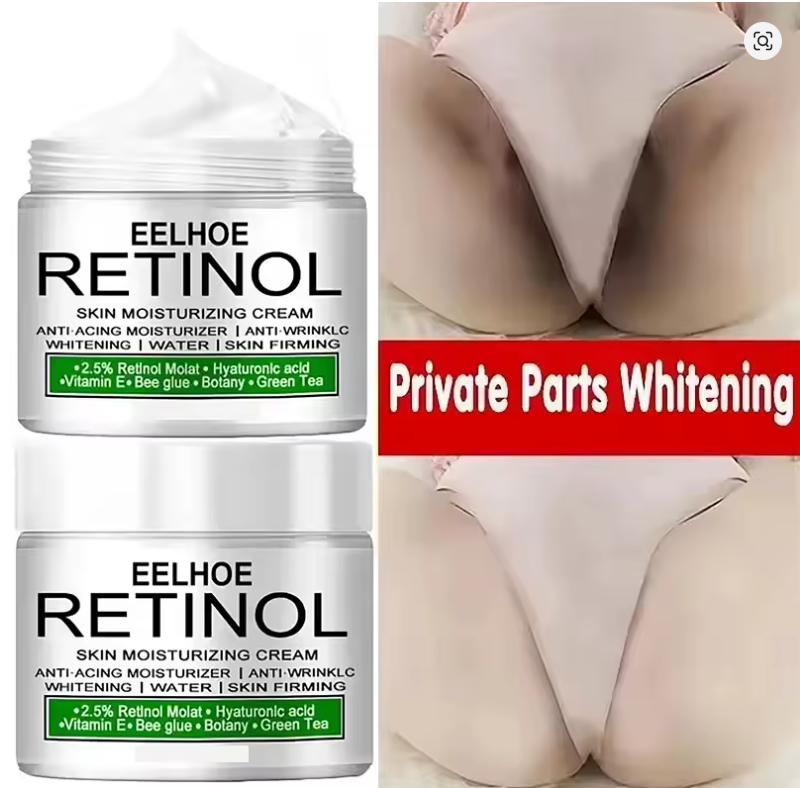
Retinol Eelhoe Private Area whitening Cream
Quantity
Free Shipping
On orders over ₦50,000
2 Year Warranty
Full coverage
30-Day Returns
Money-back guarantee
Product Features
- A more even looking skin tone in areas like inner thighs, bikini line, underarms, or around the groin area
- Smoother texture
- A “cleaner” looking appearance (this wording shows up a lot in marketing, even if it is vague)
- Texture support
- Surface renewal
- The look of uneven tone (on normal facial skin, typically)
- Post blemish marks over time, depending on the case
- Thinner and more sensitive
- Exposed to more friction (tight clothing, walking, sweating)
- More likely to react to fragrance, preservatives, harsh alcohols, and strong actives
- More likely to sting if your skin barrier is already stressed
- Peeling
- Redness
- Burning or stinging
- Tightness
- Itchiness
- Darker looking patches after irritation (post inflammatory hyperpigmentation can happen for some skin types)
- Fragrance or essential oils
- Harsh preservatives you personally react to
- Drying alcohols
- Multiple strong actives layered together (retinol plus acids plus “brighteners” can be too much)
- Glycerin
- Panthenol
- Ceramides
- Hyaluronic acid (not perfect for everyone, but common)
- Squalane
- Mild occlusives that reduce water loss
- External skin only
- Never on mucous membranes
- Never inside the vagina
- Never on open cuts, freshly shaved skin, or irritated skin
- Apply a tiny amount to a small area of skin (like the inner thigh but not right on the most sensitive fold)
- Leave it on, do not wash off immediately unless it burns
- Monitor for 24 to 48 hours
- No itching, burning, rash, or angry redness? Then maybe proceed
- Week 1: 1 to 2 nights total
- Week 2: 2 nights total
- Week 3+: only increase if there is no irritation
- AHA/BHA exfoliants
- Peels
- Strong brightening serums
- Harsh soaps or antiseptic washes in the same area
- Friction (tight clothing, thighs rubbing)
- Shaving bumps and irritation
- Hormonal changes
- Genetics (very common)
- Post inflammatory marks
- Chronic dryness and repeated inflammation
- It might improve the look of rough texture over time
- It may gradually support a more even looking surface tone if irritation is avoided
- It may help with the look of old marks in some people, slowly
- Permanent “whitening”
- Dramatic shade change in a week
- A medical level treatment for pigmentation causes
- Reduce friction (looser underwear, breathable fabrics)
- Gentle cleansing (no harsh scrubbing)
- Moisturize consistently
- Treat shaving irritation (or change hair removal methods)
- Avoid random bleaching mixtures and harsh soaps
- You have recurring itching, burning, or rash
- You have sudden dark patches that are spreading
- The area is painful, cracked, or inflamed
- You suspect an infection, fungal issue, or eczema
- You are prone to keloids or severe hyperpigmentation after irritation
- You are pregnant or breastfeeding (retinoids are generally a “check with your doctor” category)
- Buy from a seller that shows clear photos of packaging and batch details
- Avoid listings with no ingredient list at all
- Be cautious with “too cheap to be real” pricing
- Read recent reviews, not just the top ones
- If the product smell is extremely perfumed, do not use it on sensitive areas
- Do not apply right after shaving or waxing
Retinol eelhoe private parts whitening cream
 If you have seen Retinol Eelhoe private parts whitening cream online, the pitch is usually pretty similar.
It is marketed as a skincare cream for sensitive areas. It leans hard on the word retinol. And it talks about “even tone” or “brightening” or “consistent skin tone” in a way that makes it sound simple. Apply, wait, glow.
But sensitive areas are not like your elbows or cheeks. The skin is thinner, more reactive, and it gets irritated faster. So if you are considering any retinol product for private areas, you want to slow down and look at it like an adult skincare decision, not a viral trend.
This article is not medical advice. It is buyer guidance, safety context, and common sense based on how retinol behaves in skincare.
First, what this product is actually trying to do
The product is positioned as a cosmetic cream for adults who want:
Important detail though.
Those “tone” claims are brand positioning, not medical proof. Skin tone changes for a lot of reasons, and creams do not magically rewrite biology overnight.
Why retinol is the headline ingredient
Retinol is a vitamin A derivative used in skincare to support cell turnover. In plain terms, it encourages the surface layer of skin to renew more regularly. Dermatologists commonly describe retinol as an ingredient used for:
So yes, retinol has a place in adult skincare routines. That part is real.
But.
Retinol is also one of those ingredients that can behave beautifully on some people and terribly on others, especially when the skin is delicate.
Sensitive areas are not a normal testing ground
Let’s not pretend. “Private parts” skin is not just “skin but hidden”.
This area tends to be:
Sensitive skin reacts faster to active ingredients. And in intimate areas, that reaction can go from “slight dryness” to “why is my skin burning” very quickly.
This is why mild formulas matter in such areas. And why ingredient lists matter more than marketing.
The big mistake people make with retinol
Most problems come from overuse.
Overuse of strong actives leads to irritation, dryness, and discomfort. With retinol, that can look like:
And yes, you can ironically end up with more uneven tone if you irritate the area repeatedly.
What to check before you buy (especially online)
A lot of consumers in Nigeria (and honestly everywhere) buy skincare products online without clinical guidance. That is normal now. But it increases the need for careful selection.
Before you commit to any “whitening” or “brightening” cream for sensitive areas, do this:
1) Find the full ingredient list, not just the hero ingredient
If the listing only screams “RETINOL” and “WHITENING” but doesn’t show the INCI ingredient list, that is a red flag.
You want to know if it includes things that often irritate sensitive skin, like:
2) Look for barrier friendly moisturizers in the formula
Skincare brands often pair retinol with moisturizers to reduce dryness.
So look for supportive ingredients, for example:
You are not looking for “stronger”. You are looking for “less drama”.
3) Check if the product is meant for external skin only
A lot of confusion happens here.
Even if the marketing says “private parts”, you still need to assume:
If a product listing is vague, you must be strict with your own boundaries.
How to use a retinol product safely on sensitive areas (if you insist)
If you decide to try Retinol Eelhoe private parts whitening cream, treat it like a cautious experiment.
Step 1: Patch test first (seriously)
Ingredient lists and patch testing matter before full use.
A basic patch test:
Patch testing does not guarantee zero reaction later, but it reduces blind risk.
Step 2: Start slow, not daily
If you have never used retinol on sensitive body skin, starting daily is where people mess up.
A safer ramp:
Step 3: Use a very small amount
More product does not mean faster results. It usually means faster irritation.
Thin layer. That is it.
Step 4: Avoid combining with other “actives”
Do not mix this with:
If you are trying to “speed up results” by stacking actives, you are basically inviting a reaction.
Step 5: Moisturize, but keep it simple
A gentle, fragrance free moisturizer can help reduce dryness. If you are already seeing dryness, step back. Do not push through.
Step 6: Stop immediately if you feel burning
Some tingling can happen with actives, but intimate areas are not the place to “tolerate discomfort”.
If it burns, stings, or the skin feels raw, stop.
What kind of results are realistic (and what is not)
Let’s talk expectation.
Results vary based on skin type, usage frequency, and formulation strength. Also, the cause of the darker skin matters. For example, darker tone can come from:
So what can a mild retinol product realistically do?
What it cannot promise?
If the marketing suggests instant transformation, ignore that part.
The bigger point: healthy skin is not a shade goal
This matters, especially with intimate area skincare.
Healthy skin focuses on comfort, hygiene, and protection rather than appearance pressure.
A lot of people start using these creams because they think they are “supposed” to look a certain way. But uneven tone in underarms, inner thighs, groin, and bikini line is common and often normal.
If you still want to care for the area, the safest “brightening routine” is often boring:
Then if you add an active, you add it slowly and carefully.
When you should talk to a professional instead
Professional skincare advice can significantly reduce misuse and skin reactions. For instance, molluscum contagiosum is a skin condition that could arise from improper skincare practices.
Consider speaking with a dermatologist or qualified clinician if:
These situations often require professional intervention rather than DIY solutions.
Buying online in Nigeria: quick safety checklist
If you are purchasing skincare products online without guidance, keep it practical:
Also, if you react badly, stop early. Do not keep applying because you think it is “purging”. Irritation on sensitive skin is not a badge of progress.